| Message |
NHRA Rulebook 4:10 ROLL BARS
Mandatory in all cars running 11.49 or quicker, or per Class
Requirements. All roll bars must be within 6 inches of the rear or side of the driver’s head, extend in height at least 3 inches above the driver’s helmet with driver in normal driving position, and be at least as wide as the driver’s shoulders or within 1 inch of the driver’s door. Roll bar must be adequately supported or crossbraced to prevent forward or lateral collapse. Rear braces must be of the same diameter and wall thickness as the roll bar and intersect with the roll bar at a point not more than 5 inches from the top of the roll bar. Crossbar and rear braces must be welded to main hoop. Sidebar must be included on driver’s side and must pass the driver at a point midway between the shoulder and elbow. Swing-out sidebar permitted. All roll bars must have in their construction a cross bar for seat bracing and as the shoulderharness attachment point; cross bar must be installed no more than 4 inches below, and not above, the driver’s shoulders or to side bar. All vehicles with OEM frame (i.e., pickup truck where body bolts to framerails) must have roll bar welded or bolted to frame. Installation of frame connectors on unibody cars does not constitute a frame; therefore, it is not necessary to have the roll bar attached to the frame. Unibody cars with stock floor and firewall (wheeltubs permitted) may attach roll bar with 6-inch x 6-inch x .125-inch steel plates on top and bottom of floor bolted together with at least four 3/8-inch bolts and nuts, or weld main hoop to rocker sill area with .125-inch reinforcing plates, with plates welded completely. All 4130 chrome moly tube welding must be done by approved TIG heliarc process; mild steel welding must be done by approved MIG wire feed or approved TIG heliarc process.Welding must be free of slag and porosity. Any grinding of welds prohibited. See illustration. Roll bar must be padded anywhere driver’s helmet may contact it while in driving position. Adequate padding must have minimum 1/4-inch compression or meet SFI Spec 45.1.
4:11 ROLL CAGE
Mandatory in all cars running quicker than 10.99 seconds or faster than 135 mph, or per Class Requirements. Cars with unaltered firewall, floor, and body (from firewall rearward, wheeltubs permitted) running between 10.00 and 10.99, roll bar permitted in place of roll cage, or per Class Requirements.
All cage structures must be designed in an attempt to protect the driver from any angle, 360 degrees. All 4130 chrome moly (CM)tube welding must be done by approved TIG heliarc process; mild steel (MS) tube welding must be approved MIG wire feed or TIG heliarc process.Welding must be free of slag and porosity. Any grinding of welds prohibited. Additionally, roll cage must be padded anywhere the driver’s helmet may contact it while in the driving position. See illustrations on page 87. With driver in driving position, helmet must be in front of main hoop. If helmet is behind or under main hoop, additional tubing,same size and thickness as roll cage, must be added to protect driver. Main hoop may be laid back or forward, but driver must be encapsulated within the required roll-cage components. On unibody cars with stock floor and firewall (wheel tubs permitted), the roll cage may be bolted or welded to the floor/rocker box via 6-inch x 6-inch x .125-inch steel plates similar to the roll bar attachment requirements of paragraph 4:10, page 74. Unless attaching to OEM floor or frame, the minimum requirements for a frame member to which a roll-cage member is attached are 1 5/8- inch x .118-inch MS or .083-inch CM round and/or 2-inch x 2-inch x .058 MS or CM rectangular. All cage structures must have in their construction a cross bar for seat bracing and as the shoulder-harness attachment point; cross bar must be installed no more than 4 inches below, and not above, the driver’s shoulders, or to side bar. All required rear braces must be installed at a minimum angle of 30 degrees from vertical and
must be welded in. Side bar must pass the driver at a point midway between the shoulder and elbow. Unless an OEM framerail is located below and outside of driver’s legs, a rocker or sill bar, minimum 1 5/8-inch x .083 CM or .118 MS
or 2-inch x 2-inch x .058-inch CM or MS rectangular, is mandatory in any car with a modified floor or rocker box within the roll-cage uprights (excluding 6 square feet of transmission maintenance opening). Rocker bar must be installed below and outside of driver’s legs and must tie into the main hoop, the forward hoop, frame, frame extension, or side diagonal. Rocker bar may not tie into swing-out
side bar support. If rocker bar ties into side diagonal more than 5 inches (edge to edge) from forward roll-cage support or main hoop, a 1 5/8-inch x .083 CM or .118 MS brace/gusset is mandatory between the diagonal and forward roll-cage support or main hoop. Swing-out side bar permitted on OEM full-bodied car, 8.50 e.t. and slower. The following requirements (a through d) apply:a. 1 5/8-inch O.D. x .083-inch CM or .118-inch MS minimum.Bolts/pins must be 3/8-inch-diameter steel, minimum and in double shear at both ends.
b. Male or female clevis(es) permitted. Male clevis must use two minimum 1/8-inch-thick brackets (CM or MS) welded to each roll-cage upright; female must use minimum 1/4-inch-thick bracket (CM or MS) welded to each roll-cage upright. Pins must be within 8 inches of the vertical portion of both the forward and main hoops. A half-cup backing device must be welded to the vertical portion of the main hoop (inward side) or the upper end of the swing-out bar (outward side), minimum .118-inch wall (CM or MS) extending at least 1 5/8 inches past the center of the pins. A clevis assembly using a minimum .350-inch-thick male component and two minimum .175-inch-thick female components may use a 1/2-inch-diameter Grade 5 bolt and does not require a half-cup backing device. c. Sliding sleeves of 1 3/8-inch x .083 CM or .118 MS, with minimum 2-inch engagement, are permitted in lieu of the upper pin/cup. d. All bolt/pin holes in the swing-out bar must have at least one hole diameter of material around the outside of the hole. On all cars requiring a roll cage, if the OEM firewall has been modified (in excess of 1 square foot for transmission removal, not including bolted-in components), a lower windshield or dash bar of 1 1/4 x .058-inch 4130 chrome moly or 1 1/4 x .118-inch mild steel
is mandatory for connecting the forward cage supports.
Whew
DO IT!

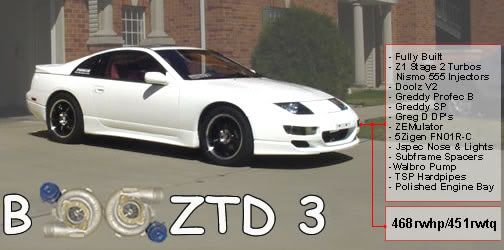
Correct......503rwhp/488rwtq
|
 |


